














How can privacy in digital environments be protected in a way that accounts for people’s differing vulnerabilities? The policy paper makes clear that many people are not adequately protected when the focus is placed primarily on individual cookie settings and on strengthening the privacy literacy of average users. Vulnerable groups in particular – such as children, older people, or people with cognitive impairments – often cannot adequately assess the risks of data sharing and are at greater risk of being harmed by privacy violations.
Vulnerability, however, is not a static personal characteristic; it arises in context and is shaped differently depending on the technical, social, or institutional environment. Classic anti-discrimination categories such as gender, race, or age therefore often fall short. Instead, the interdisciplinary DiversPrivat research team proposes adopting a diversity perspective that does not determine protection needs solely on the basis of group membership, but takes into account concrete, situational vulnerabilities in the respective digital context. Against this backdrop, the policy paper offers both conceptual and ethical recommendations on how privacy can be protected in a diversity-sensitive way, as well as practical recommendations regarding user-interface design, the further development of the legal framework, and science communication.
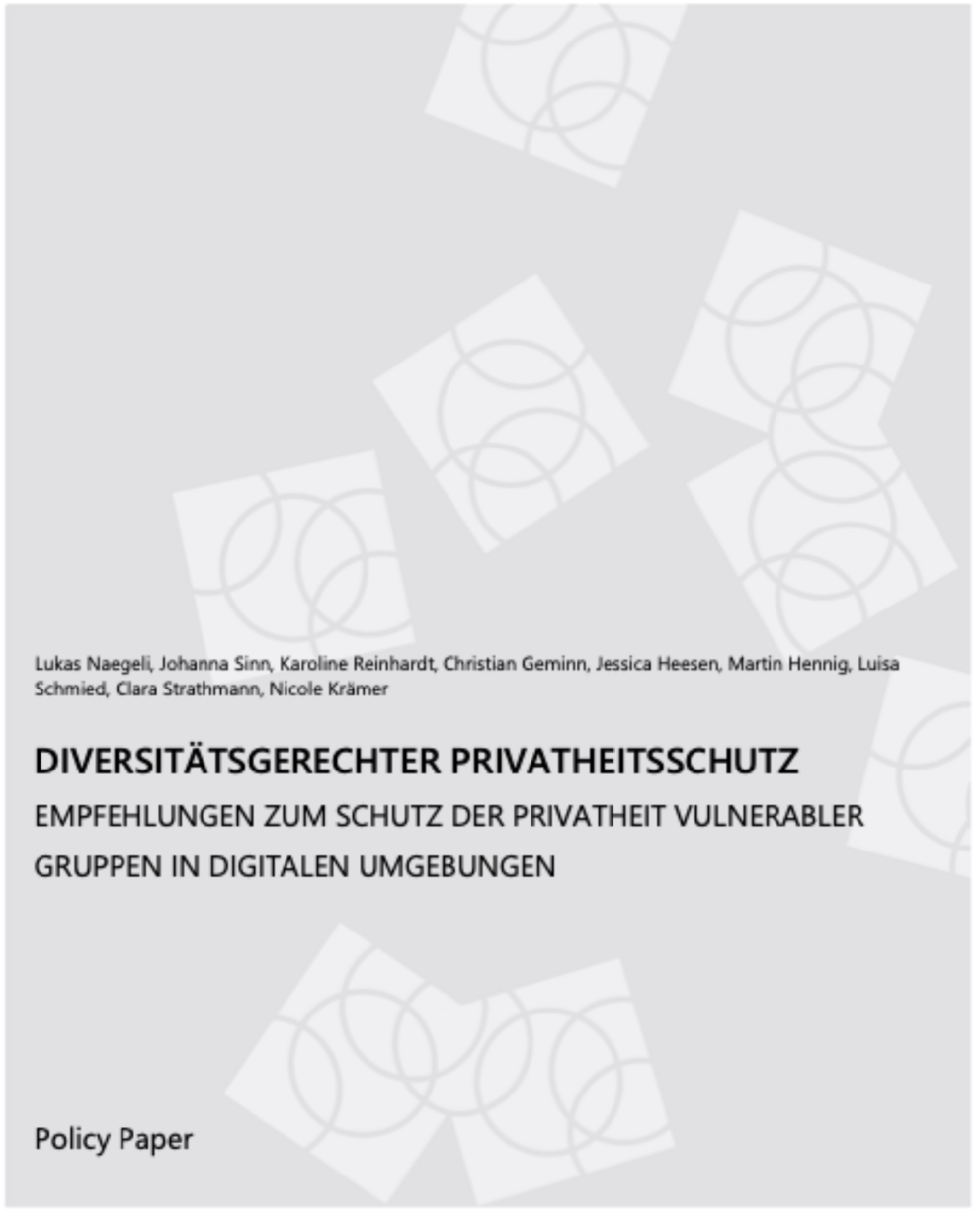
Naegeli, L.; Sinn, J.; Reinhardt, K.; Geminn, C.; Heesen, J.; Hennig, M.; Schmied, L.; Strathmann, C.; Krämer, N. (2026): Diversitätsgerechter Privatheitsschutz. Empfehlungen zum Schutz der Privatheit vulnerabler Gruppen in digitalen Umgebungen. Forschungsberichte der Plattform Privatheit, Nr. 7, Hrsg. v. Friedewald et al. Karlsruhe: Fraunhofer ISI.