

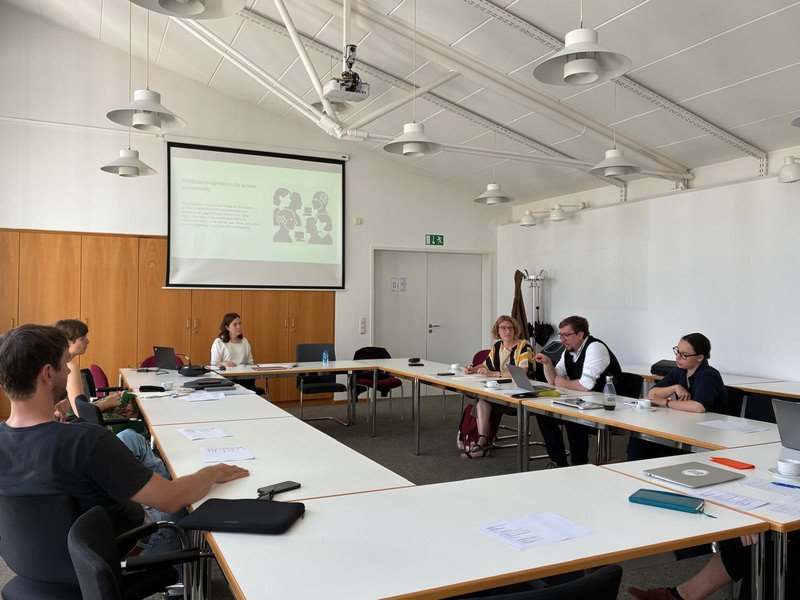
An interdisciplinary workshop for young academics took place at the University of Passau on June 13 and 14: “Political Imagination(s) - between Democracy and Digitality”. Perspectives and projects from applied ethics, political theory, philosophy, business informatics and cultural studies were discussed.
The focus was on the questions: Can imagination and the power of imagination be used as a driving force to shape democratic institutions? Which imaginative potentials promote the development of which alternative institutions and infrastructures? How does digitality in turn change human imagination? The discussion covered fundamental considerations on the concept of imagination, the relationship between democracy and imagination, as well as specific examples.
The first keynote speech was given by Prof. Dr. Silvana Mandolessi from the Catholic University of Leuven. She showed the development of different ideas and hopes in relation to digital technologies, from the euphoria of the internet as a place of free and equal exchange to current hacking practices. On the second day, the keynote speech reflected the spirit of the workshop as an opportunity for young academics: Dr. Sergej Seitz from the University of Vienna spoke about the crisis of the democratic imagination and how it can be countered by looking at concrete initiatives.
Five young researchers from the University of Passau presented excerpts from their work: Dr. Lea Watzinger dealt with the metaverse with regard to its political significance and Jonas Riefle with regard to concrete technical design possibilities. Marie Hirsch presented fundamental considerations on the use of political metaphors. Johanna Sinn and Dr. Stefan Christoph dealt with negative and dystopian ideas in AI ethics and conspiracy theories.
The workshop was part of the university's Graduate Centre funding programme and was organized and led by Dr Lea Watzinger (Political Theory) and Johanna Sinn (Applied Ethics). The two young academics are very satisfied with the event: "A workshop with enough time to develop and discuss ideas is a great opportunity to get to know new specialist perspectives. With the financial support of the Graduate Center, it was also possible to make contacts outside the University of Passau, which is particularly important during the qualification phase. We are delighted that the Graduate Center made this possible!"
The press release can also be found here: Press release.

 Share this page
